In a food processing plant, the hygienic management of knives is a critical control point: if they are not properly sanitized between uses, they can become a source of cross-contamination. Pathogens such as Listeria monocytogenes, Salmonella or E. coli can persist on stainless steel surfaces and compromise product safety, with direct impact on audits, compliance and operational continuity. At Inoxsis we design and supply two professional solutions for the sterilization of knives in industrial environments: UV-C disinfection cabinets and ozone disinfection tanks.
Both technologies are aligned with the hygiene requirements applicable to the food industry and are easily integrated into production lines, although they operate with different operating principles and recommended uses.
In this article we compare how each system sterilizes, what you can expect in terms of efficacy and in which scenarios UV-C or ozone is more appropriate.
Step-by-step process – Inoxsis knife sterilization cabinet
Pre-cleaning of knives
Before putting the knives in the cabinet, remove any organic debris with water and/or detergent. The organic matter acts as a screen that blocks UV-C radiation and prevents its effectiveness. Pre-cleaning is a mandatory step.
Placement in individual knife holders
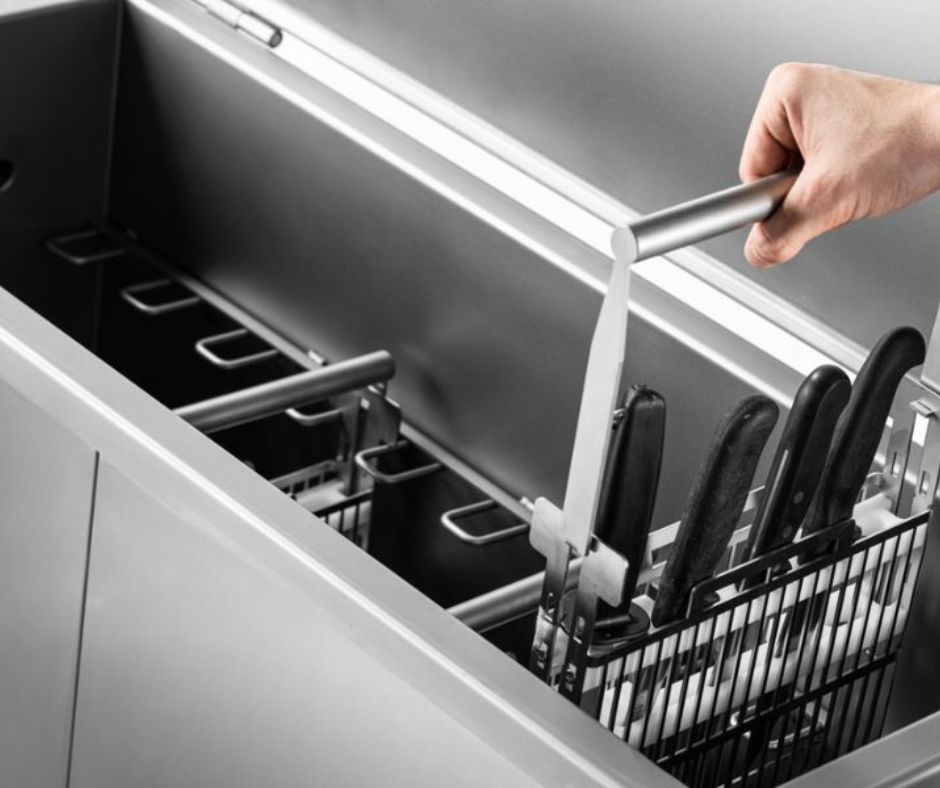
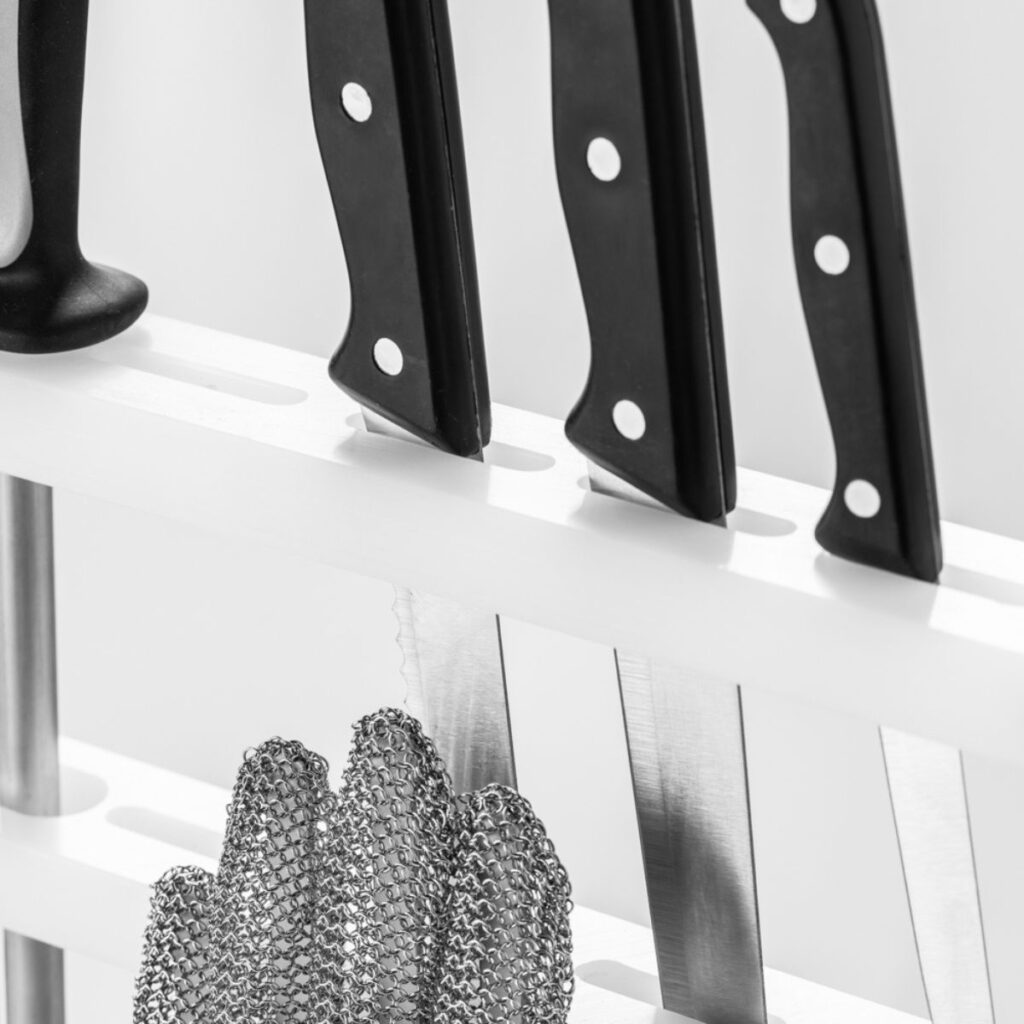
Each knife is placed in its individual knife holder in the stainless steel cabinet. It is essential that the knives do not touch each other and that all blade surfaces are directly exposed to light. Shaded areas (e.g. one blade covered by another) will not receive the radiation and will remain unsterilized.
UV-C irradiation
Once the cabinet door is closed, the UV-C lamps are activated and emit radiation continuously on the utensils. The UV-C wavelength (especially around 254 nm) causes the most damage to the genetic material of microorganisms.
Immediate extraction and use
Once the cycle is finished, the knives are ready to be used again. There is no waiting time, no drying or rinsing and no chemical residue is left on the metal surface. The cabinet can be reloaded immediately for the next cycle.
UV-C light does not pass through solids. If shadows are present, there are unsterilized areas. The design of the individual Inoxsis knife holders maximizes exposure of the entire blade surface.
Efficiency of the UV-C system
UV-C radiation is highly effective against the vast majority of foodborne pathogens:
- Vegetative bacteria (Listeria monocytogenes, Salmonella spp., E. coli O157:H7): elimination greater than 99.9% with correct exposures.
- Viruses (Norovirus, Hepatitis A): high sensitivity to UV-C radiation.
- Fungi and yeasts: very sensitive, rapid elimination.
- Bacterial spores: partial efficacy; require very high doses to be completely inactivated.


2. Ozone sterilization (O₃).
Ozone (O₃) is a molecule consisting of three oxygen atoms that acts as one of the most powerful oxidizing agents available. Unlike UV-C, ozone is a gas that expands and reaches all surfaces in an enclosed space, regardless of its geometry. Its mechanism of action is completely different from that of light: it oxidizes and destroys the cell membranes of microorganisms by direct contact.
Step-by-step process – Inoxsis sterilization tank or cabinet for knives and knife-holders
Pre-cleaning of knives
As with the UV-C system, mechanical pre-cleaning is essential. Ozone is a powerful oxidizer, but the presence of abundant organic matter can consume some of the gas and reduce its effectiveness on microorganisms. Removing visible debris maximizes the performance of the cycle.
Loading in stainless steel tank or cabinet
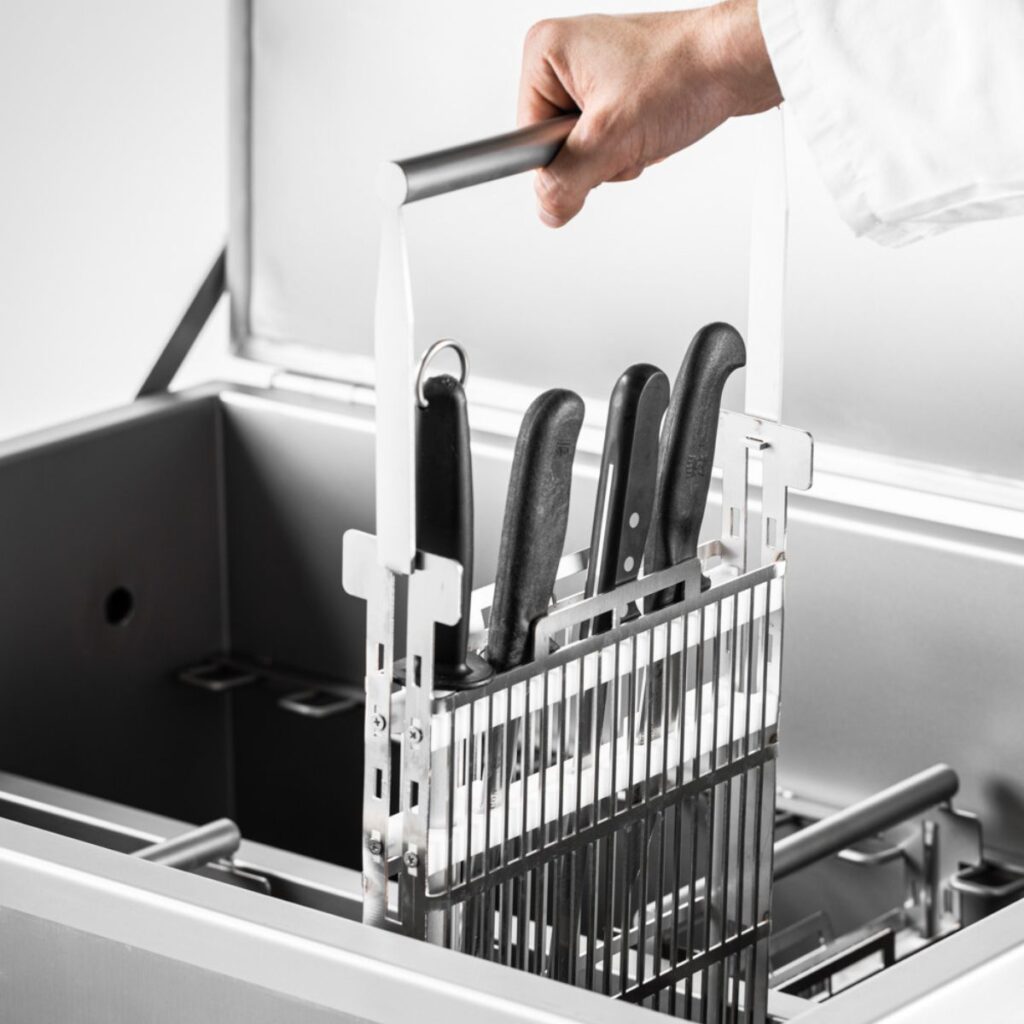
The knives, with or without their knife holders, are placed in the sterilization tank. Unlike UV-C, placement is less critical in terms of direct exposure: as ozone is a gas, it will reach the handle-blade junction, the slots, the recesses of the knife holder and any shaded area that light could not reach. Mesh gloves or knife sharpeners can be included in the same cycle.
In situ ozone generation and space saturation
The generator integrated in the tank produces ozone directly from the oxygen in the ambient air (no external chemical storage is required). The gas expands and saturates the inside of the sealed tank until it reaches the concentration required for sterilization.
Natural ozone degradation
Once the active cycle is completed, the ozone spontaneously degrades into ordinary oxygen (O₂). This is one of the great virtues of the system: it leaves no chemical residue on the utensils or in the environment. In addition, the cabinets incorporate a preset program with safety lock, so that, once the cycle has been activated, the door cannot be opened until the process is completely finished, guaranteeing the safety of the operators and the correct execution of the treatment.
Removal of utensils
After the ventilation time has elapsed, the knives and knife holders can be removed and used or stored directly. The surface is completely free of residues and no additional drying is required.
Ozone is a gas and it gets everywhere. The handle-blade junction, slots and any shaded areas receive the same dose as flat surfaces. This is the main advantage over UV-C.
Ozone system efficiency
Ozone stands out for having one of the broadest biocidal spectra of all available disinfection systems:
- Vegetative bacteria: elimination greater than 99.9%, including resistant forms.
- Bacterial spores: high efficiency, unlike UV-C.
- Virus (enveloped and non-enveloped)
- Fungi, yeasts and biofilms: oxidation of the membrane and destruction of the biofilm matrix.
- Elimination of odors: ozone decomposes odor-causing molecules.
3. Which system is more effective for knife sterilization: UV-C or ozone?
The answer depends on your workflow, tool geometry and the level of safety required by your HACCP plan.
UV-C knife sterilization and ozone are complementary systems. The former stands out for its speed in sterilizing directly exposed surfaces. The latter is best when it is necessary to ensure that no part of the utensil is left untreated, or when spores and biofilms are to be eliminated in end-of-day cycles.
A combined solution integrating the two systems – the UV-C cabinet for quick sterilizations throughout the day and the ozone tank for the deep end-of-shift cycle, offers a maximum level of food safety with total flexibility.
In Inoxsis we advise you to determine which option best suits your production process, your volume of tools and the requirements of your HACCP plan.