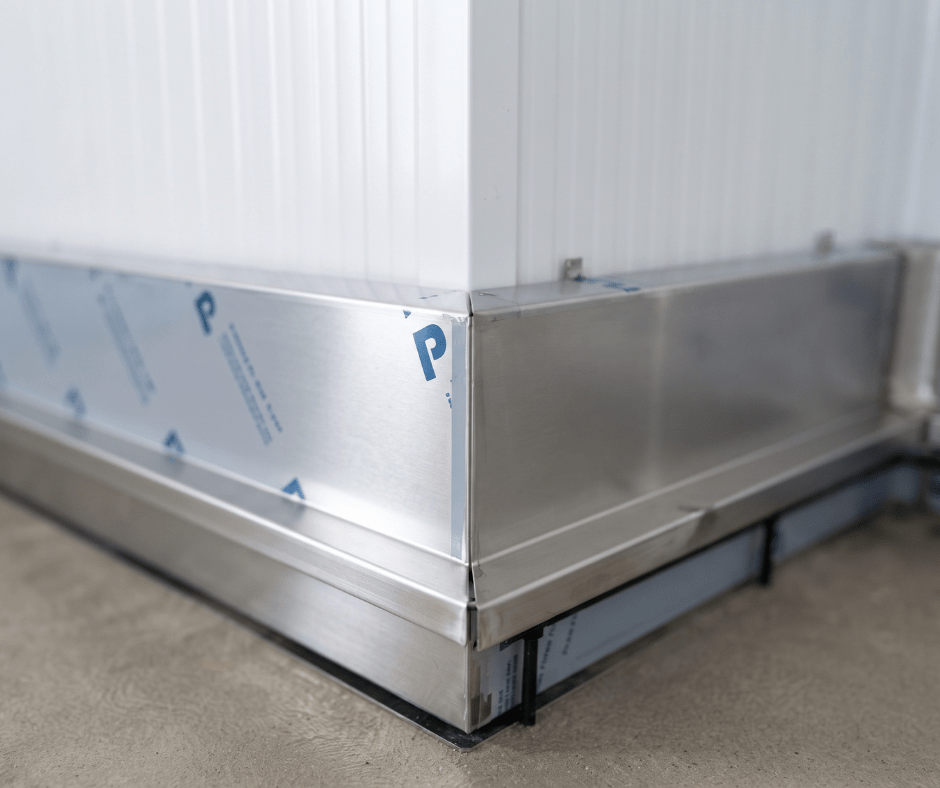
Food-industry furniture consists of fixed and auxiliary equipment, made of washable and corrosion-resistant materials, that allows staff to change clothes, store their clothing, and enter the production area with clean and disinfected hands and footwear. The standard material is AISI-304 stainless steel: it does not absorb moisture, withstands detergents and disinfectants, and does not promote the growth of bacteria. Its primary location is the changing room, the plant’s first hygiene barrier: this is where the hygiene chain required by HACCP plans and food safety audits begins.
At INOXSIS, we design and manufacture everything needed to fully equip a locker room out of stainless steel, in three phases:
- Changing Room Setup: lockers, benches, apron and boot hangers, and boot dryers.
- Hand hygiene: single and multi-person sinks, automatic sinks with integrated drying and disinfection, soap dispensers, and hand dryers.
- Disinfection before production: access control with hand disinfection and washing, and washing and disinfection of shoe soles and boots.
This industrial workwear is also required in sectors with strict hygiene and health standards, such as: meat and poultry, dairy, seafood, industrial baking, institutional catering, the pharmaceutical and cosmetics industries, laboratories, and hospitals.
1. Equipment and Locker Room Organization
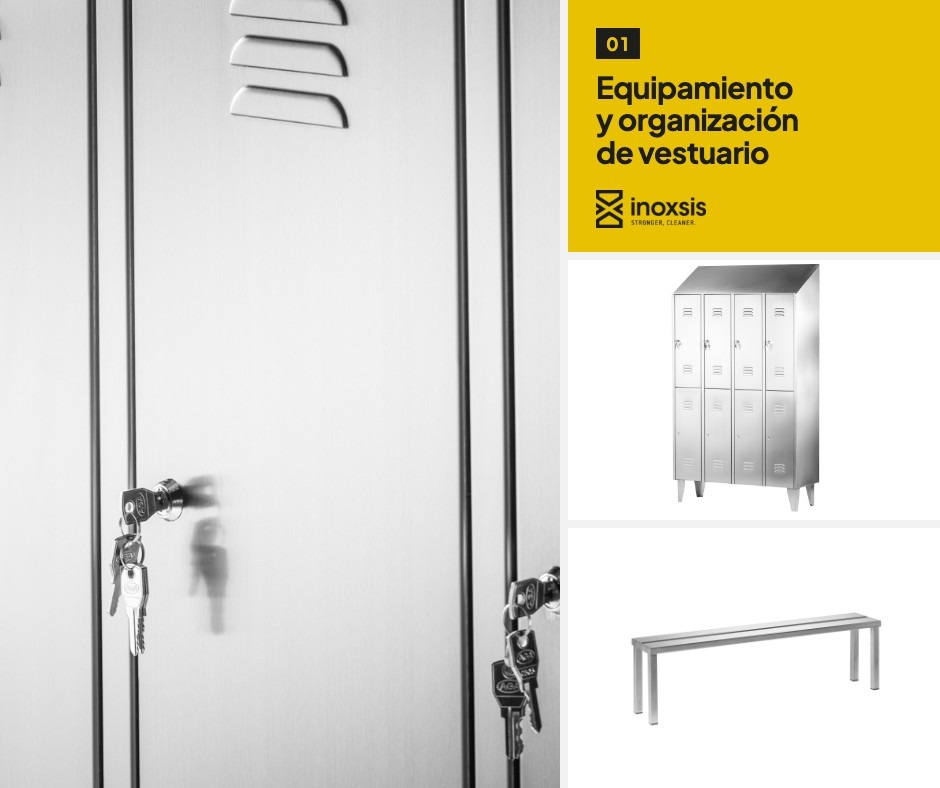
A well-organized locker room keeps street clothes separate from work clothes and prevents boots and aprons from being left on the floor or on surfaces that are difficult to clean.
All INOXSIS locker room furniture is made of AISI-304 or AISI-316 stainless steel, depending on the customer’s requirements.
Locker Room Lockers (LK)
The stainless steel lockers store each employee’s clothing and personal belongings. They measure between 2,100 mm in height and 450 mm in depth, with widths ranging from 300 to 1,500 mm. They feature a sloped top, which prevents objects and dust from accumulating on top, and four legs that leave the floor clear for cleaning.
- LK11 through LK15 (long door, 1 to 5 doors): bottom shelf, top shelf with hangers, and lockable door.
- LK21 to LK25 (half-door, 2 to 10 doors): two compartments per module, with a bottom shelf and a hanging rod; they double the capacity in the same space.
Changing Room Benches (BK10, BK15, and BK20)
These stainless steel benches allow users to change their shoes comfortably and serve as a boundary between the dirty and clean zones. They are available in lengths of 1,000, 1,500, and 2,000 mm, with a depth of 300 mm and a seat height of 450 mm.
Apron Hangers (HA14 and HA15)
They keep aprons separate, ventilated, and off the floor. The HA14 holds 10 aprons, and the HA15 holds 15.
Boot Racks (HA16 and HA40)
The boots are placed upside down to drain and dry. The HA16 holds 16 boots, and the HA40 holds 40 boots.
Combined Boot and Apron Racks (HA06, HA10, and HA20)
These units combine each worker’s footwear and apron in a single piece of furniture. Capacities: HA06, 12 pairs of boots and 6 aprons; HA10, 20 pairs of boots and 10 aprons; HA20, 40 pairs of boots and 20 aprons.
Boot Dryer (DB05)
The boot dryer dries and sanitizes the inside of up to 40 boots. It combines a 1,000-watt heating element, a fan, and an ozone germicidal lamp that reduces bacteria and odors. Keeping the inside of boots dry prevents mold and extends the life of the footwear.
2. Hand Hygiene
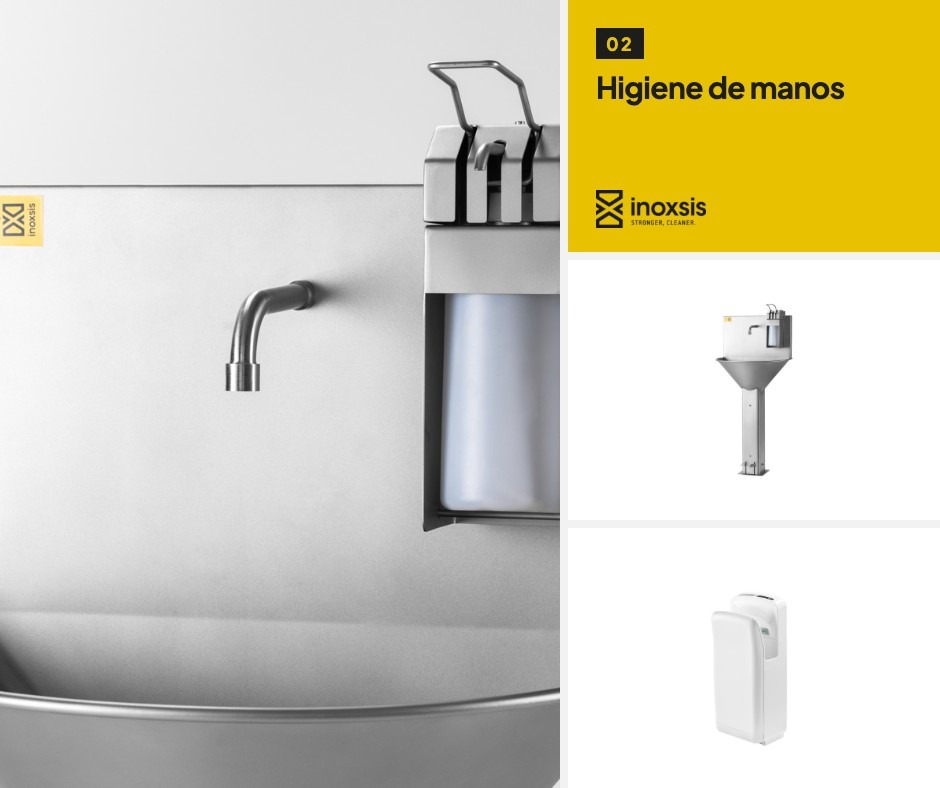
Hands are the primary source of cross-contamination in a food processing plant. That is why the changing room must include a complete hand-washing station: water, soap, and a way to dry hands, without touching the faucets with your hands.
Individual handwashing stations
For small changing rooms or high-traffic areas. INOXSIS manufactures models with various touchless activation mechanisms: hip-activated (HW21), foot-pedal-activated (HW11, HW01, and HW59), and photoelectric sensor-activated (HW21F, HW11F, and HW01F).
Multi-station sinks (HW12/HW12F through HW16/HW16F)
Designed for facilities with shift changes, where many people wash their hands at the same time. They feature 2 to 6 faucets (HW12 to HW16) on a single sink with a base, hot and cold water, and a soap dispenser included.
Activation options: foot pedal or photoelectric sensor
- Foot pedal: sturdy and requires no electricity; the operator turns on the water with their foot.
- Photoelectric sensor: Water flows when hands are brought close to the sensor and stops automatically, reducing water consumption.
In both cases, contact with the faucet—one of the places where bacteria accumulate most—is eliminated.
Soap Dispensers
All sinks come with a standard soap dispenser. As an option, INOXSIS offers a lever-operated stainless steel soap dispenser, which is more durable and easier to clean.
Hand Dryer (DH01)
The DH01 automatic hand dryer dries hands with air flowing at 95 m/s. It features an antibacterial coating, a water collection tank, a safety shut-off after 30 seconds, and automatic warm air when the ambient temperature drops below 25 °C.
3. Disinfection before entering the production area
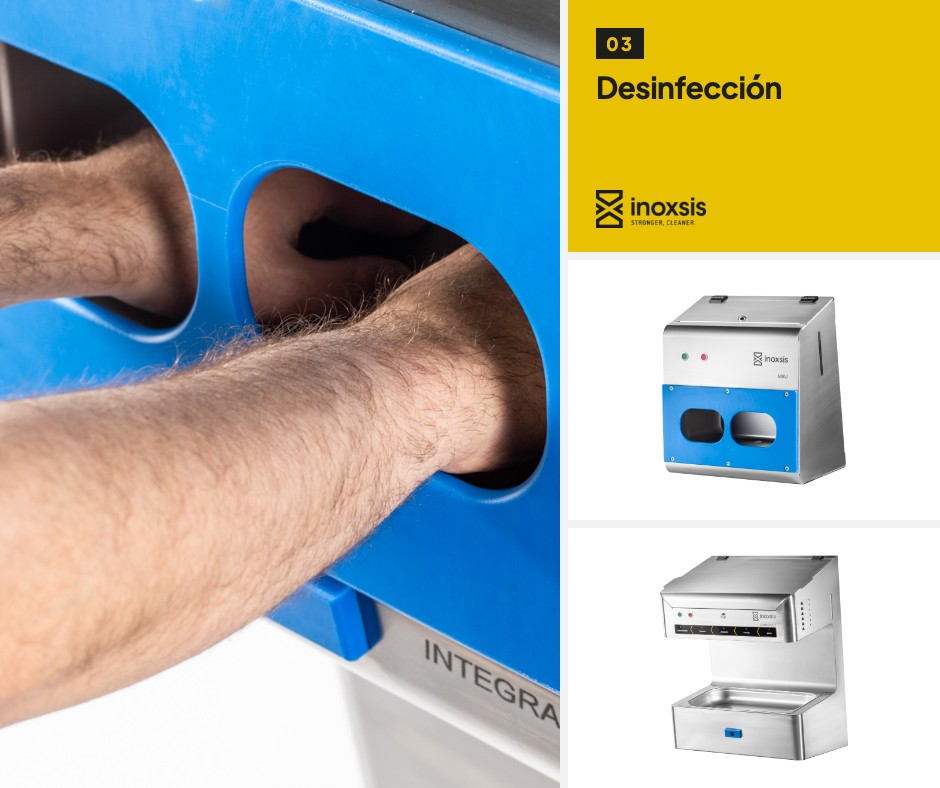
The final step in the locker room is the sanitation checkpoint: no one is allowed to enter the clean zone without first disinfecting their hands and shoes. This checkpoint is organized into three functions.
Hand Sanitization
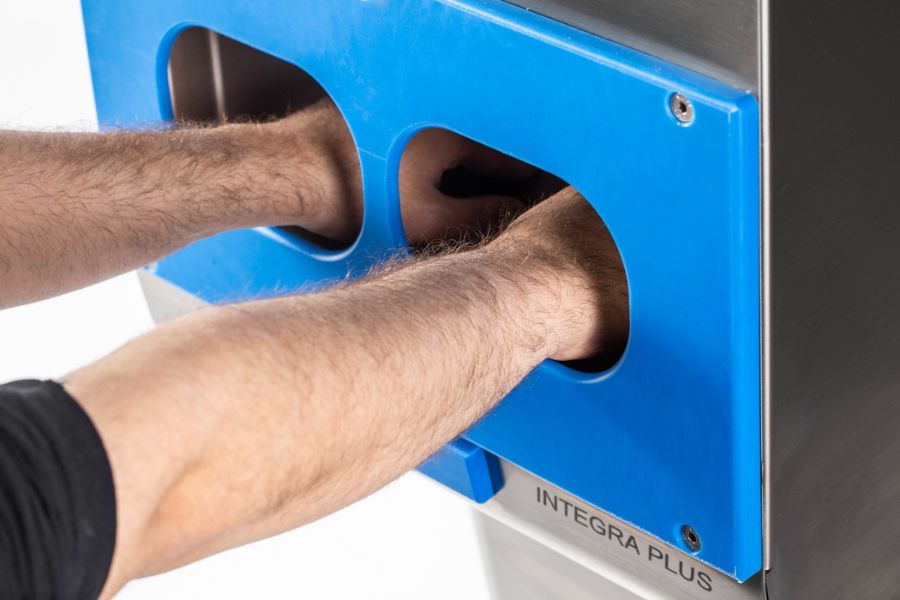
Automatic, contactless sanitizer dispensers with photoelectric sensors. The BASIC model is wall-mounted, with a 1-liter reservoir, for low- to medium-traffic areas. The INTEGRA PLUS is floor-mounted and features a 20-liter reservoir for high-traffic areas.
Learn more about hand sanitizing equipment.
Washing and Disinfection of Shoe Soles and Boots
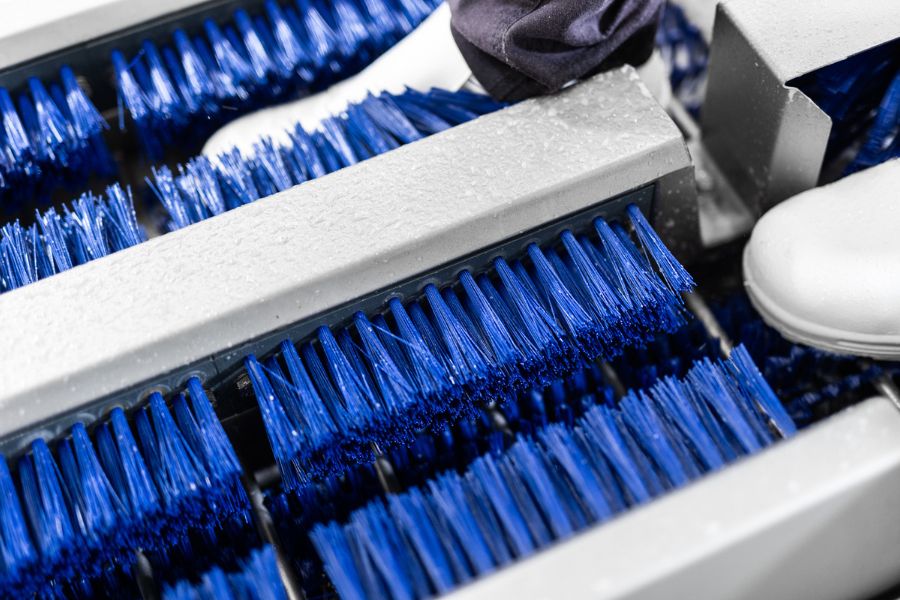
Soles carry organic debris and microorganisms from one area to another. INOXSIS sole and boot washers clean the soles with rotating brushes and automatically apply disinfectant.
We’ll explain why industrial boot disinfection is so important and how to choose a boot washing station.
Access Control
A turnstile or tripod gate only allows entry once the hygiene cycle is complete. This ensures that disinfection is no longer dependent on individual compliance and is guaranteed at every entry point.
INTEGRA PASS and COMPACT PASS Hygiene Stations
To complete the circuit, the changing room can end at a hygiene station that combines all three functions into a single piece of AISI-304 stainless steel equipment:
- INTEGRA PASS: a hygiene corridor featuring photoelectric hand sanitizing, shoe sole sanitizing, and a turnstile. The INTEGRA PASS-300 model completes the cycle in 5 seconds and can be equipped with a biometric screen that tracks entry times.
- COMPACT PASS: a compact station that washes, dries, and sanitizes hands and cleans shoe soles with two 700-mm rotating brushes. The COMPACT PASS-320 is equipped with 4-liter soap and sanitizer reservoirs.
Not sure which one to choose?
Check out the INTEGRA or COMPACT PASS-320 models : which hygiene station to choose.
Industries that require hygienic workwear
This protective clothing is required in the meat, poultry, dairy, and seafood industries; industrial baking and pastry production; central kitchens and catering; the pharmaceutical, cosmetics, and chemical industries; and laboratories and healthcare facilities.
Frequently Asked Questions
What materials should be used for furniture in the food industry?
Stainless steel, preferably AISI-304 or AISI-316. It is corrosion-resistant, does not absorb moisture, and can withstand daily cleaning.
What equipment is needed in a food-processing facility locker room?
Lockers, benches, boot and apron hooks, boot dryers, touchless sinks, soap dispensers, hand dryers, and a station for disinfecting hands and shoe soles before entering the production area.
Why do the lockers have sloped tops?
To prevent objects or dust from accumulating on top. Together with the legs, which keep the floor clear, they facilitate cleaning and prevent hidden areas of dirt.
Is a foot-operated or photoelectric sink better?
Both prevent you from touching the faucet. The foot pedal doesn’t require electricity and is very sturdy; the photocell automatically shuts off the water and reduces consumption.
What is the difference between INTEGRA PASS and COMPACT PASS?
Both hygiene stations disinfect hands and shoe soles and control access. INTEGRA PASS is a modular hygiene corridor; COMPACT PASS combines hand washing, drying, and disinfection with shoe sole washing in a smaller space.
Is this changing room suitable for the pharmaceutical industry?
Yes. The same equipment is used in the pharmaceutical and cosmetics industries, as well as in laboratories and hospitals, where it is also necessary to separate areas and control access hygiene.
Equip Your Entire Locker Room with INOXSIS
At INOXSIS, we design and manufacture furniture for the food industry that requires a locker room: from lockers to the hygiene station that provides access to production areas. Our technical team will help you size the locker room according to the number of employees, shifts, and available space.
You can contact our advisory team or browse our locker room accessories and personal hygiene equipment.